Wednesday, December 21, 2011

Everything is Gold in Bangkok

The grand temples and palaces of Bangkok is a grand invitation to Thailand’s architecture appreciation, rich cultural heritage and religious background. But once I step in any Wat (temple) or look upon a chedi (pagoda) or stupa (Thai buddhist monument), one color or ensemble adorning every structure caught my attention – gold. From ornate walls to windows up to the pointed roofs, every temple or palace in Bangkok seems to be bejeweled and carved out of gold. Each are sparkling. Each are beautifully designed like life-sized jewelries. Each spells gold. My wanderings to these temples and palaces let me have an ultimate gold experience in the country but it also let me appreciate the Thai architecture and culture in all forms.

The ultimate burst of gold - The Temple of the Reclining Buddha.
Wat Benchamabophit - Bangkok's finest architecture.
 Wat Benchamabophit, often referred as “The Marble Temple” is the most beautiful temple I have seen in Bangkok. The gold and orange embellishments of the roof has attracted my attention for its very detailed designed and amazing architecture. The marble that has made the halls, floors and columns of the temple which is said to be imported from from Italy, just secondly caught my attention. But nonetheless, it is also a stunning work of Thai architecture. Wat Benchamabophit’s stunning and marvelous architecture is one of the best I have seen in the city that will surely caught the eyes of every Bangkok visitor.

Ornate roofs of structures inside the complex of Wat Benchamabophit.
A closer look to the intricate design of one of the windows.
I save the visit to the main temple as the last stop to explore. So I immediately explore the surrounding structures like Bovonvong Bell Tower and  Sri Somdej Pavillion. Bovonvong Bell Tower is a typical style of Thai architecture, roofed with glaze tiles and walled with marble slabs. The open sided Sri Somdej Pavillion houses several drums like Shan drum, a 16 foot long  drum carved from a block of rosewood.

Shan drum at Sri Somdej Pavillion.
 After seeing the surrounding pavilions and structures like monk’s quarters, its time for me to explore the beautiful temple. The marble part if the temple made it a real classy structure. The ubosot (Thai hall) sits in one wall of a cloister. The cloister is lined with many Buddha images which was unusual. Whereas most temple, all the Buddha images would be more or less the same, but in Wat Benchamabophit every image is different. Some are seated while some are standing, all with different poses and each has different meaning.

The golden roofs of the Marble Temple.
The different images of Buddha found in the cloister of the temple.


Explaining the position and meaning of the Buddha image.
 Phra Buddhajinaraja at the altar and the main buddha image in Marble Temple.
The ubosot (hall) is covered by marble which made it attractive by the layered and ornate orange and gold roof designs of the temple. The altar and its main buddha image, Phra Buddhajinaraja are the most beautiful in Thailand. The image is enthroned against a dark sky-blue background. A golden flame frames the image. The windows of the temple are a type of stained glass in yellow and white. The ceiling is a beautiful beamed of colors of dark red and gold.

One of the Buddha images different from one position from another.
The main facade of the temple.
I leave Wat Benchamabophit with an unforgettable memory of its beautiful and beaming orange and gold colored roofs along with the fluttering red, blue and white flag of Thailand and the yellow flag seal of the Royal Kingdom. The temple is located opposite one corner of Chitlada Palace (the official residence of the Thai royal family) in the Dusit district. The Marble Temple was featured in the famous reality TV show, The Amazing Race 9 as the 10th and final elimination pit-stop.

Wat Benchamabophit was 10th and final elimination stop of famous reality TV show Amazing Race 9.
Post-card perfect photo of the Marble Temple.
The Grand Palace is a grand invitation to Thailand’s rich history, religious background and unique Thai architecture. Yet it is also a grand invitation to the Thailand’s gold experience! From The Marble Temple, we move to Grand Palace to explore its treasured sites and temples where each seems to be almost carved in gold and bejeweled in architecture.

Grand Palace is a complex of temples and palaces in Rattanakosin district. For 150 years, it has been a home of the King and his court as well as the administrative seat of the government. Thai kings stopped living in the palace full-time around the turn of twentieth century, but the complex remains the seat of power and spiritual heart of the kingdom. There is a strict dress code for visiting the Grand Palace. Inside the complex, where the Temple of the Emerald Buddha also sits, is Thailand’s most sacred site. Visitors must be properly dress before being allowed to enter the temple like men should wear long pants and shirts with sleeves and woman should wear close shoes, modestly dressed and no see through or bare shoulder dress.

A grand invitation...
The Upper Terrace golden and bejeweled structures will greet you once you enter the Grand Palace.
The legend of Ramakien painted in the cloister of the complex.
Once you enter the Grand Palace, the cloister wall paint of Ramakien legend and the structures of Upper Terrace will greet you.  Ramakien is the Thai version of the Hindu epic Ramayana where each scenes is painted on the complex’s cloisters. First painted during the reign of King Rama I, the painted scenes were made bold and attractive with the highlights of gold embellishments. The first scene of story is found next to the east gate. Surrounding the gate port of entries are towering statues of Yakshas or guarding demons to guard Grand Palace against evil spirits. 

Phra Siratana Chedi - highest gold intensity experience!
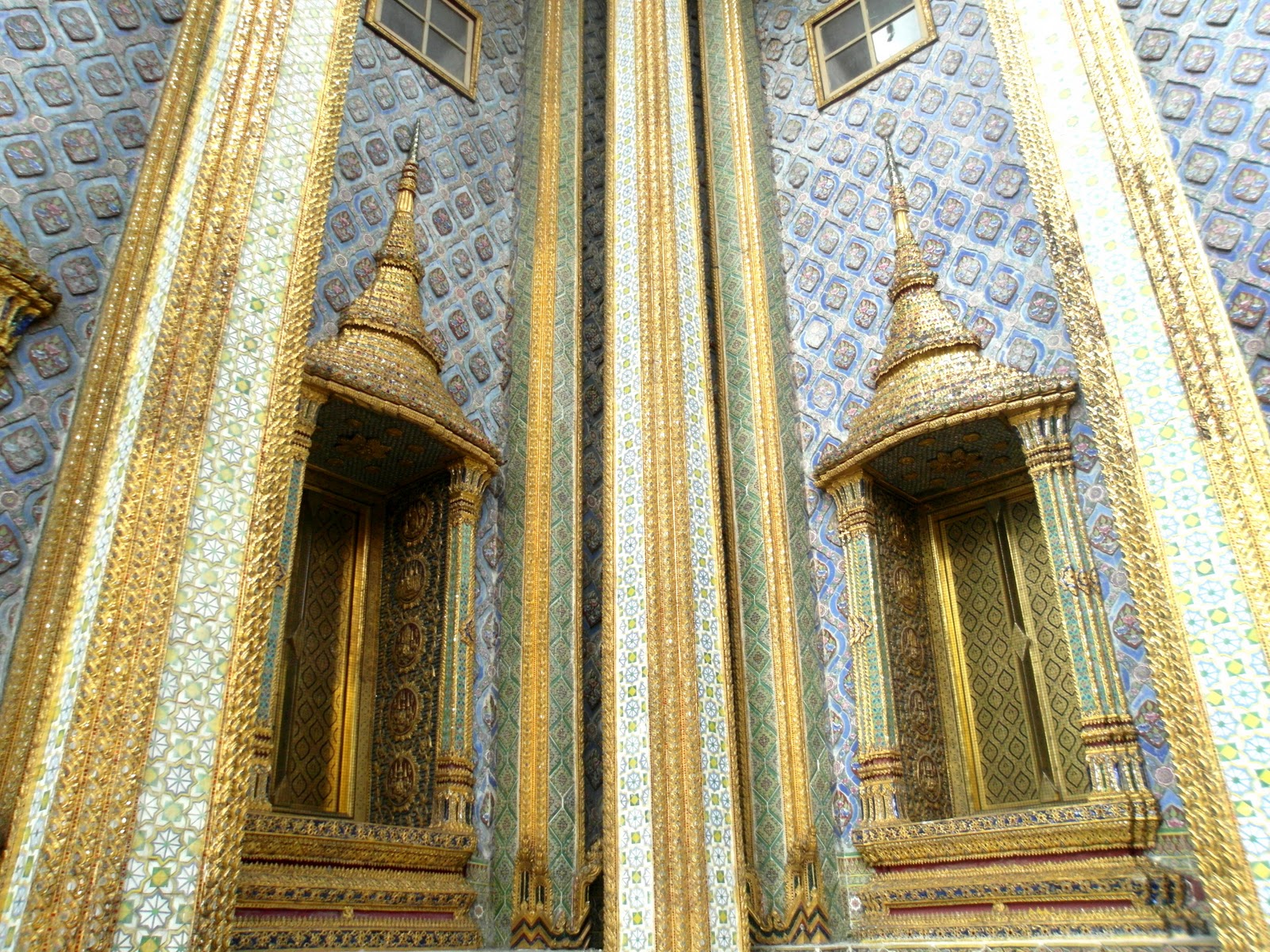
Bejeweled and golden - The Royal Pantheon's walls and windows.
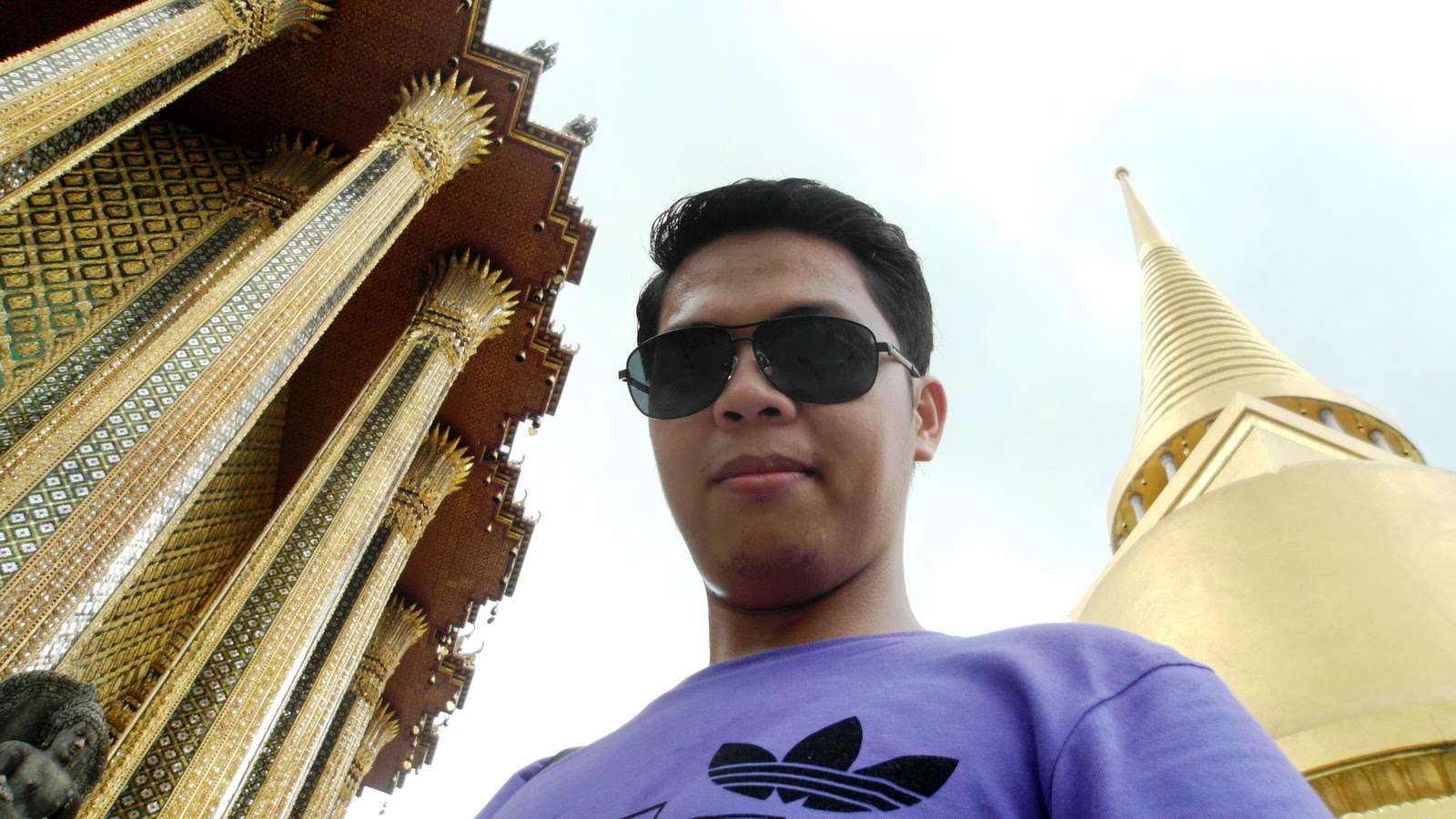
Phra Mondop (left) and Phra Siratana Chedi (right).
 
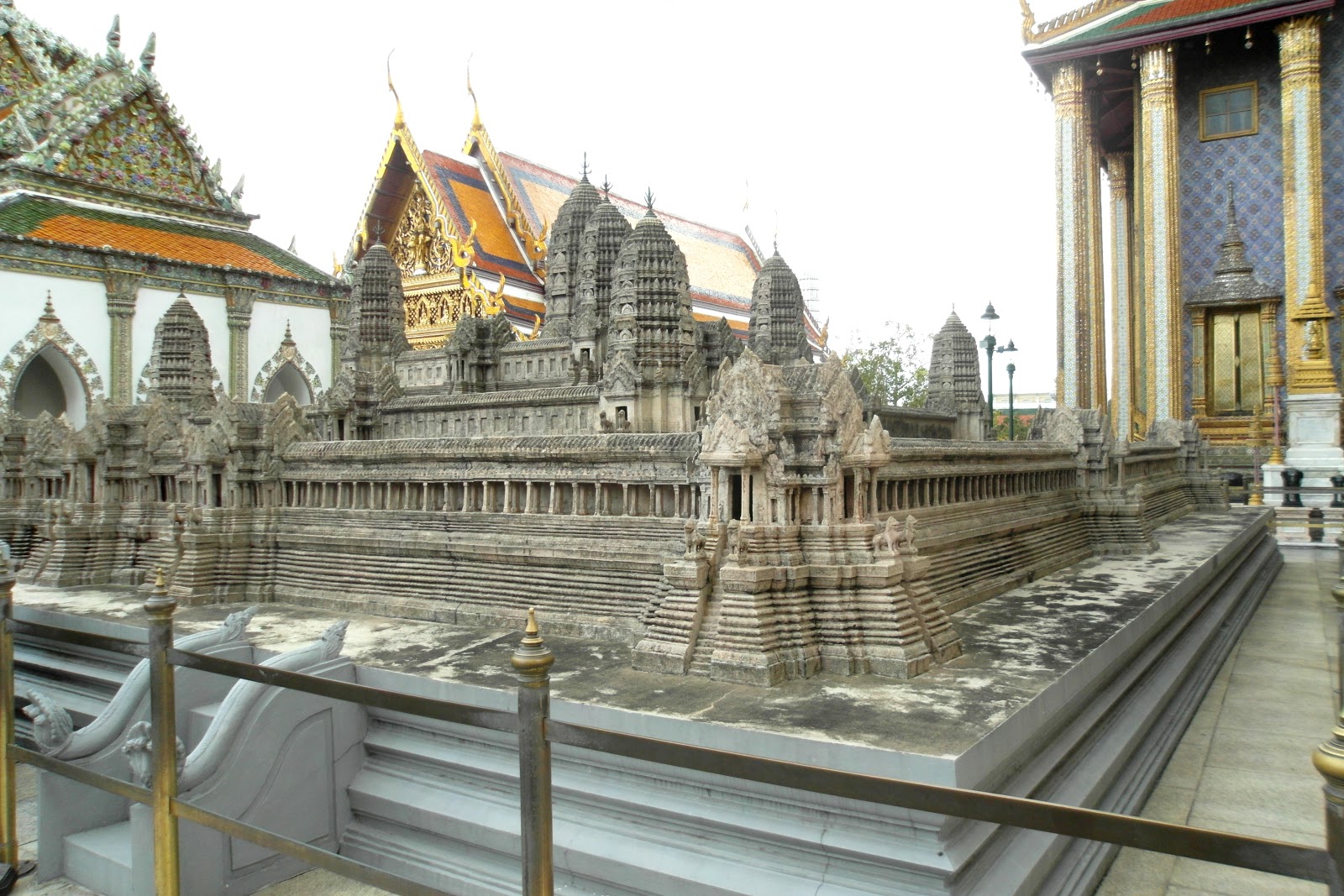
Model of Angkor Wat of Cambodia.
The Upper Terrace comprises Phra Siratana Chedi, Phra Mondop, Prasat Phra Dhepbidorn or the Royal Pantheon and a model of Angkor Wat.  Among the four structures, Phra Siratana Chedi and The Royal Pantheon caught my attention the most because of its golden and bejeweled architecture. The Phra Siratana Chedi with its golden chedis is the highest gold intensity experience among the structures because of its wholly painted gold building. The golden chedi shines ultimately in gold whenever the sun bask its sunshine on it! Beside it, is Phra Mondop, the building is a repository of sacred Buddhist scripture inscribed on palm leaves, contained within a mother-of-pearl inlaid cabinet. While the Royal Pantheon or Prasat Phra Dhepbidorn  From every columns, walls, doors, windows up to the roofs, everything seems to be laid with jewelries and precious stones. The design is very detailed and beautifully patterned like the intricate designs of a jewelry. The building becomes stunning and classic with the royal blue and gold color complement that dominates the whole structure. The Royal Pantheon is where the statues of past sovereigns of the ruling Chakri Dynasty are enshrined. Scattered around the Upper Terrace, are statues of elephants and mythical beings like Kinnara. The models of elephants are a record of the famous white elephant acquired during the reigns of the various kings of Thailand.

A grand invitation to unique and stunning Thai architecture.
Neighboring to the Upper Terrace is the Temple of the Emerald Buddha or Wat Phra Kaew. The temple has a very ornate and detailed designed roof in multicolored layer of dark blue, orange and yellow. The outside structure is designed with golden intricate patterns that also extends to its columns and outer walls. But the real attraction of the temple is the Emerald Buddha found inside the hall of the temple. I take a peak inside the altar by removing my shoes and seated on the floor. Taking photos inside are not allowed. The Emerald Buddha is actually carved from a block of jade and first discovered in 1434. It was initially thought made of emerald , hence the name of the image. The image is enshrined on a golden traditional Thai-style throne made of gilded carved wood. The throne sparkles in gold designs which I admire along with its surrounding stunning jewel-like patterns that looks difficult to make. A look into the thrones’ accessory designs made like small temples will make you feel like in a trance because of its gleaming and sparking pattern. It is like jewelries glittering everywhere in Wat Phra Kaew.

The stunning Royal Pantheon.
A closer look to the golden and bejeweled wall of Wat Phra Kaew.
An exit to the surrounding cloister is the entrance to the Phra Maha Monthian, Chakri and Dusit group of buildings. I explore the Amarindra Winitchai Hall where the main feature is a throne surmounted by a nine-tiered white umbrellas and backed by a boat-shape altar. The throne is wholly made of golf and and if not its accessories are encrusted with real gold! That’s why it is heavily guarded, visitor’s are allowed to view it from a certain distance only and taking photos of the throne is not allowed. I learned that the hall was built in 1785 during the reign of King Rama I and used for a number of state ceremonies such as birthday anniversary of the king.

The grand palaces and temples of Grand Palace!
Chakri Maha Prasat Hall, left and next to it is Dusit Maha Prasat Hall.
Chakri Maha Prasat Hall is used for reception of foreign ambassadors and state banquets.
We exited through Snamchand Pavilion that lead us to one of the grandest palace inside the complex, the Chakri Maha Prasat Hall. It is a stunning palace with golden embellishment roof design but what makes it unique is incoporating a European style architecture to the building. The manicured trees and plants surrounding its facade added a pleasant viewing of the palace. Chakri Maha Prasat Hall was built in 1882, the same year as the centenary celebration of Bangkok. The different halls of the building is used for the reception of foreign ambassadors and state banquets.

Neighboring to the Chakri group is the Dusit group of buildings. This group consists of the Dusit Maha Prasat Hall and Amphorn Phimok Prasat Pavilion.  The Dusit Maha Prasat Throne Hall was built by King Rama I and intended the present building to be use for his own lying-in-state ceremony. Today, is still remains as the lying-in-state of kings, queens and honored members of the royal family. The hall has an admirable four-tiered roof brightly encrusted with gold and intricate patterns and layered green and orange covers. It is topped with seven-tiered spire also made of intricate gold patterns. Also a structure who wouldn’t be left behind in gold embellishment structures is the Amphorn Phimok Prasat Pavilion. Aside from the elaborate design and architecture, its gold design extends to its columns and wall lines. This design makes it one of the most stunning pavilion inside the Grand Palace.

Snamchand Pavilion (the grey structure) leads an entrance to the Chakri and Dusit group of buildings.
The golden pedestal and the Emerald Buddha at Wat Phra Kaew.
Dusit Maha Prasat Hall (back with golden spire) and Amphorn Phimok Prasat Pavilion (front and smaller structure).
I am amazed in each architectural designs of the structures inside the Grand Palace. Each seems to be laid with jewels and gold! The beautiful pattern designs are hard to duplicate. Yet the boldest of all the designs or colors found inside the complex is gold! The single color that always caught my attention. The only color that dominates each temple and palace. In Grand Palace, everything is gleaming in gold, gold, gold.

Almost a neighbor to Grand Palace is Wat Pho or better known as the Temple of the Reclining Buddha. This is where I experience an ultimate burst of gold because of the biggest image of reclining Buddha I have seen sparkling wholly in gold! The moment I step into the grounds of Wat Pho, a lot of visitors were already inside the hall to catch a glimpse of the golden image. The soles of the statue’s feet are inlaid with mother-of-pearl showing 108 auspicious signs of the Buddha. This is the largest and most beautiful piece of fine arts of the Buddha image in a reclining position found in Thailand. Even the walls and columns where it is contained is reflecting gold colors because of the golden gleam of the image.

Gold, gold, gold - The Golden Reclining Buddha, the biggest buddha image in Thailand.
3 of the group of 4 huge pagodas called Phra Maha Chedi Si Rajakarn inside the grounds of Wat Pho.
Painted murals inside the walls of Temple of the Reclining Buddha.
As I explore the grounds of Wat Pho, I saw an almost endless surrounding double cloisters in the courtyard called Phra Rabieng. In these cloisters, the canopies has admirable pattern designs too. But what caught my sight are the hundred buddha images lining in the cloisters. There are 400 images to be exact all gleaming in gold! I proceed to explore Phra Uposatha, the main chapel and heart of the monastery. Inlays of mother-of-pearl on the outer side of the entrance door panels depict episodes from the Ramakien, while on the inner side are painted specimens of ecclesiastical fans of rank which are presented to the monk sovereigns. The principal budhha image inside the main chapel is Phra Buddha Deva Patimakorn. It is in a gesture of seated Buddha in a three tiered pedestal and some ashes of King Rama I are kept under the pedestal. While my eyes is gleaming in gold again, I also notice the mural paintings inside the hall. It is also the only chapel that is allowed to photograph the Buddha image while on the altar. Proper seating gesture is strictly observed inside the chapel like feet should not point directly to the Buddha image or its pedestal. Outside the chapel, the chapel’s double marble walls surrounding it called Kampaengkaew had a symbolic architecture. There are 8 sheltered gates and 8 sculpted boundary stones.

The huge image of the golden reclining Buddha.
A faithful praying inside Phra Uposatha with the Phra Buddha Deva Patimakorn buddha image at the altar.
Some of the numerous small spires found inside Wat Pho.
Inside the grounds of Wat Pho, I’ve also noticed the four huge and tall spires or pagodas surrounded by white wall with Thai-Chinese style sheltered gates decorated with colored-glazed tiles and Chinese rockeries guardians. This group of four huge pagodas called Phra Maha Chedi Si Rajakarn is 42 meters high and elaborated with colorful mosaics. Actually the four pagodas represent the four kings of the Chakri Dynasty while there are also smaller pagodas found inside the temple that contains the holy relics of Buddha or for the purpose of keeping the ashes of the royal descendants. Phra Maha Chedi Sri Sanpetdayarn is the green tile mosaic pagoda represents the reign of King Rama I. The one with white tile mosaic representing the reign of King Rama II is named Phra Maha Chedi Dilok Dhammakaroknitarn,  It was built by his son, King Rama III. He also built the yellow tile mosaic pagoda, Phra Maha Chedi Muni Batborikharn, for his own reign and for the praise of Buddha. The last one is Phra Maha Chedi Song Phra Srisuriyothai in dark blue tile mosaic is the most beautiful of the four tallest pagodas. I find the dark blue tile designs a true royalty and class. It represents the reign of King Rama IV or King Mongkut.

This spires and pagodas in Wat Pho has a significant historical value and admirable designs but the ultimate burst of gold is still the reclining golden Buddha. It is the center of gold experience in Wat Pho. Though, the hot weather and high sun can discourage you to explore further the grounds of the temple, Wat Pho is a worth visit for an enriching learning about Thailand and it rich cultural heritage. 

Phra Maha Chedi Muni Batborikharn represents the reign of King Rama III.
The dark blue tile pagoda, Phra Maha Chedi Song Phra Srisuriyothai.
Phra Maha Chedi Si Rajakarn.
When I visited Wat Benchamabophit, it suits its another name as The Marble Temple for it is the most beautiful temple I saw in Bangkok. Its marble columns and floors gleams classiness in it that perfectly matches to its ornate and intricate designed golden roofs. It has a very admirable architecture. When I visited the Grand Palace, I was submerged to its golden and bejeweled architectures.  Each structure is stunning and in everywhere I look or glance, I always see gold! Yet Grand Palace is a grand invitation to the Thailand’s history discovery, rich culture and unique architecture. When I visited Wat Pho, I believe I reach my ultimate gold experience in Bangkok. It almost submerge me in a trance because of the burst of gold all-over the huge reclining Buddha that I never seen before. The pagodas and spires surrounding the temple proves the rich religious background and history of the country. I won’t be surprise if James Bond’s famed nemesis Auric Goldfinger would love Bangkok. Because he loves only gold and in Bangkok everything is gold!


-----------------------------------------------------------------
Everything is Gold in Bangkok is part of my Thailand's Amazing Smiles series where I share my wonderful trip to the land of amazing smiles last October 25-28, 2011. Other "gold" experience you may have in Bangkok is by visiting Wat Saket or Golden Mount, Loha Prasat and  Wat Traimit or Temple of the Golden Buddha. For a helpful trip to Bangkok visit Bangkok for Visitors website for more information.You might also like the other parts of the series:

Monday, December 12, 2011

Going Green: Ecotourism, the new trend in travel!

A new and popular trend in travel is making waves and I believe most of us heard a lot about it. Ecotourism is trending now in travel! Especially in our country whose provinces highly depending on it nowadays. Ecotourism is one of the key components of Green Travel. It a new kind of tourism that encourages green travel but at the same time encourages and promotes community's active participation, development and economic growth in the area where ecotourism site is.

Hundred Islands National Park, an ecotourism site in Pangasinan.
In the country, especially in the tourist provinces, ecotourism is highly practice like in Palawan and Bohol. The government done several acts and laws and to strengthen and support ecotourism in our country. It also at the same time help the surge of tourists in the ecotourism sites of the province. The result is many people in the community places depend on it like their everyday livelihood, income and development aside from the promotion of the province as a destination of choice. More and more people are visiting the ecotourism sites and more provinces are developing their ecotourism potential to invite visitors and gearing up for this kind of travel as a result as well. It also enables the provinces to gear up for this kind of travel because of its positive and beneficial effects to the province and community. The good concept of ecotourism is that not only the place or tourism site is promoted but also encourages a sustainable tourism by giving enviromental awareness, taking care and preserving the place and at the same time help the people around it in their livelihood and income through participation and education about it. Ecotourism promoted both community growth, provincial tourism and green travel!

Here's a concrete definition and principle of Ecotourism: Ecotourism  is a form of sustainable tourism within a natural and cultural heritage area where community participation, protection and management of natural resources, cultural and indigenous knowledge and practices, environmental education and ethics as well as economic benefits are fostered and pursued for the enrichment of host communities and satisfaction of visitors. Ecotourism helps in sustaining the development of the country as it aims to protect our natural resources, on which the ecotourism industry depends. 

Loboc River in Bohol - one of the ecotourism sites in the Philippines.
Principles of Ecotourism:
Ecotourism is about uniting conservation, communities, and sustainable travel. This means that those who implement and participate in ecotourism activities should follow the following ecotourism principles:

* Minimize impact.
* Build environmental and cultural awareness and respect.
* Provide positive experiences for both visitors and hosts.
* Provide direct financial benefits for conservation.
* Provide financial benefits and empowerment for local people.
* Raise sensitivity to host countries' political, environmental, and social climate.

Ecotourism in the Philippines
The Philippine Department of Tourism's hat has been thrown into ecotourism game for awhile now. They've made it part of their plan for economic development. The country's ecotourism program strives to install processes and procedures that are economically beneficial, socially responsible, ecologically sustainable and advantageous to the local communities by creating jobs and improving living conditions overall. Palawan is the second biggest province in the country in terms of land area and has been recommended by the tourism department as the top eco-destination in the country.

Ecotourism Activities
There are a variety of eco-friendly activities available for the ecotourist to enjoy: Swimming with whale sharks in the their natural environment or getting out the binoculars and watching for the rare Philippine Eagle or 600 other varieties of birds. A traveler can also go to a jungle environment survival training camp where he or she can be taught to drink from a water vine, cook in a bamboo steamer and dine off a bamboo plate. Other activities include Trekking/Mountaineering, Wildlife Watching, Scuba Diving/Snorkling, Caving, Kayaking/Rafting and Surfing.

Eco-friendly Resorts
The Department of Tourism recommends The El Nido, Lagen and Miniloc Island Resorts, Club Noah Isabelle and the Bohol Bee Farm. These hotels all carry out environmentally friendly practices: Coastal clean ups, prohibiting the gathering of shells and coral, eco-safe cleanser and many others.

Taal Volcano from Tagaytay City - an ecotoursim site.
I'm glad that more and more province in our country are gearing up towards ecotourism. Its the new trend in travel that a lot of travelers are attracted to. And hotels and resorts are leaning to Green Hotels concepts. It only shows that ecotourism and going green is not just profitable but very helpful in the livelihood of people involve because of its positive benefits. Its has a beneficial idea and principle behind it. A sustainable tourism is a good way to practice and promote green travel. I'm glad to experience and visited some ecotourism site in our country like Bohol, Hundred Islands National Park, Taal Volcano and Tagaytay City. I hopefully to see other ecoutourism sights and places in the country like Palawan (the ecotourism capital of the Philippines), Camiguin, Mayon Volcano and Vigan. And there's a lot more ecotourism places in the country! And more potential places to develop too! May more travelers and visitors promote ecotourism in the Philippines. The beauty of nature is hard to resist and marvel. Ecotourism preserves it while sharing that beauty.  

Tuesday, December 06, 2011

Magazine cover worthy Pangasinan


While enjoying the nice beaches in Quezon Island (part of Pangasinan's Hundred Islands National Park), I saw and captured this rock formation in the island molded with natural stairs and terraces along with native cabana for visitors to enjoy. Set along a scenery cove and beach along with trees and rock formation, I instantly find the sight, a magazine cover worthy of Pangasinan in a photo. I also imagine a travel magazine with this photo on the cover and have Pangasinan as a the cover story where inside the magazine are lots of stories about trip to the province. Don't you agree this photo is magazine cover worthy?

Learn more about my Pangasinan wanderings in Alaminos' Hundred Islands National Park here.

----------------------------------------------------------
Travel Memories is a snapshot photo in my travels where one picture don't only goes as a memorable perfect travel postcard photo but also evokes a vivid memory of a happy, unforgettable and great travel experience.

Monday, November 28, 2011

Exploring Bangkok on a Tuktuk

The best way to explore Bangkok is through its very popular auto rickshaw vehicle – Tuktuk. They are readily available in every street corners of Bangkok so it is easy to spot them to get a short trip within the city. It is a very popular mode of transportation in Bangkok so there is no reason to excuse myself in a taking a wild ride of tuktuk especially as a first time visitor in Thailand.

Our tuktuk driver and city tour guide, Dalin, literally drive us through-out the city to explore its great sights ans places of interest for a whole day. Since tutuk is a small vehicle, it can easily pass through the traffic jams of Bangkok and small alleys for shortcuts. My tuktuk ride wasn’t just a great experience of exploring Bangkok but also a great way to sample the urban life scenes in Thailand’s capital.

Exploring Bangkok on a Tuktuk!
Our tuktuk driver/tour guide - Dalin, driving us in every part of Bangkok.
First thing that I noticed in the streets of Bangkok is that it is less polluted in smoke even though there are times it is traffic and heavily packed by vehicle. The streets are also cleaned, well maintained most of the time free from litters and trashes. I am also fascinated by bright and loud colored taxis that brings lively vibes to the busy streets of Bangkok. Malls and shops are in every street corners making the city a real shoppers paradise.

The streets of Bangkok on a tuktuk's eyeview.
Tuktuk can easily pass through the network streets of Bangkok. That’s why going through the nearest attractions of Bangkok just like a breeze. One of the nearest museums in Pratunam and Ratchaprarop train station is Suan Pakkad Palace. This museum is a collection f traditional Thai houses collected by Prince and Princess Chumbot. Some houses belonged to the prince’s family and all are more than a century old. Don’t miss to see the Lacquer Pavilion. It is an extraordinary example of Thai art and consists of a room within a room styled structure decorated with richly carved gilded wood.

A few short hops on tuktuk, we passed by the palace residence of the Thai monarchy, The Chitlada Palace. Though it is beautifully covered with fountains and canals in its gates, it is impossible to see the palace as it is mostly covered with trees and always close to the public. We drove to our intended destination, Wat Benchamabophit or The Marble Temple is the most beautiful temple I saw in Bangkok. It is just located opposite one corner of Chitlada Palace in Dusit district. The temple is noted for its stunning and majestic architecture which is distinctly Thai. You’ll admire the temple’s stunning architecture from the gold and orange encrusted roofs to the ubosot (hall) covered outside by marble from Italy. Take a peek into its altar and it main Buddha image (Phra Buddhajinaraja) as these is the most beautiful in Thailand. Take time also to look the surrounding cloisters of the temple where there are numerous Buddha images on display as well as significant buildings like Song Dharm Hall and Sri Sri Somdej Pavilion.

Wat Benchamabophit or The Marble Temple.
The surrounding canal inside The Marble Temple.
Wat Benchamabophit - The most beautiful temple in Bangkok!
Various Buddha images found inside the temple's cloister. 

The author and the stunning Marble Temple.
A reminder that you are in the land of smiles!
Driving past Bang Lumpoo district, I saw the Democracy Monument, a public monument commissioned in 1939 to commemorate Siamese Revolution of 1932. After a few rolls, we reach Rattanakosin where a few steps from our drop-off is the large Sanam Luang Park. On opposite of the park is one of Bangkok’s major attraction – The Grand Palace. It is a complex of palaces and temples where for 150 years was the home of King and his court. It is here where I became amaze by the different and detailed architectural structures of buildings, palaces and temples. Everything is bejewelled in gleaming stones and gold! Wat Phra Kaew or The Temple of the Emerald Buddha is the most important temple inside the complex because it houses the Emerald Buddha. Some of the most remarkable building inside the complex were The Royal Pantheon or Prasat Phra Dhepbidorn, Chakri Maha Prasat Hall and Dusit Maha Prasat Hall. All of which are architecturally stunning buildings. The Grand Palace is a grand invitation to Thailand’s rich culture, history and heritage.

The entrance facade of Grand Palace.
The grand temples and palaces of Grand Palace.
Admiring the grandeur of Chakri Maha Prasat Hall.
A grand invitation in Grand Palace.
Almost right next door is Wat Pho, better known as the Temple of the Reclining Buddha because of the reclining Buddha sparkling in gold. Aside from the golden reclining image, the temple also has four largest chedi (Thai buddhist monument or pagoda). They are decorated with ceramic tiles and three dimensional ceramic pieces which form intricate floral patterns. Its four highest chedis which is also each colored distinctly actually represents the kings who ruled the country in the past. I was surprised to learned that the four chedis is just part of the 91 chedis that can be found inside the temple. There are also 400 buddha images on display in the surrounding cloisters of the temple. All are gleaming in gold! Wat Pho is also known as the oldest temple in Bangkok and actually much older than the city of Bangkok itself. It was founded in 17th century.

The reclining golden buddha, sparkling in gold!
The stunning wall design of the reclining Buddha hall.
One section of the cloister surrounding Wat Pho with numerous buddha images.
Via tuktuk, you can also reached the Royal Barges Museum. The museum displays 8 of the 50 royal barges on display that is used in formal processions during the old Ayuthaya period. The barges on display very in size and function. The most important of all is the Suppanahong or “Golden Swan”, with its figurehead prow in the shape of a huge golden swan. Next to it is the Narai Song Suban with King Narai riding a Garuda on its prow. Around the sides and back of the warehouse are display cases with oars, flags, and other paraphernalia of the procession ceremonies.

The head of Suppanahong or “Golden Swan”
The Royal Barges in the museum.

Also in a day you can explore the almost the side by side sights of Loha Prasat (a unique temple structure in Bangkok for its “metal castle” concept and Wat Ratchanadda) and Wat Saket (or Golden Mount is located just outside the old royal city precincts, famous for the golden chedi sitting on a man-made mountain). Then you can also proceed in exploring Vimanmek Mansion. Billed as the world's largest teakwood mansion, it was built as a royal residence in the first few years of the 20th century. Its now a large complex of museums where the buildings themselves form part of the "collection" on display. Next to the mansion, the tuktuk can fetch you to the nearby Dusit Zoo. A favorite for families in Bangkok, the zoo is popular as a picnic spot as it is for the animals. The park has many food stalls with a reputation for delicious food at very low prices. Its central location makes it easy to get to.

 
Bangkok experience is not complete without taking a ride of Tuktuk. (Video)

I had a satisfying whole day exploration of Bangkok via Tuktuk!
A day exploration of Bangkok is an indulgence to the senses but it also involves tiring walks, getting lost and dealing with hot weather. So it just rightful for Dalin to drive us one of the best seafood restaurant in Bangkok to replenish energy from a tiring day. This is a great way to end my day of exploration of Bangkok – to start exploring it this time by trying Thai cuisines! Who wouldn’t agree? A tiring day of exploration needs a yummy bowl of Bangkok! 

-----------------------------------------------------------------
Exploring Bangkok on a Tuktuk is part of my Thailand's Amazing Smiles series where I share my wonderful trip to the land of amazing smiles last October 25-28, 2011. We actually did not visit Royal Barges Museum because of the flooded situation and we only passed by Suan Pakkad Palace but each site can be easily reach via tuktuk and other main attraction in Bangkok. For a helpful trip to Bangkok visit Bangkok for Visitors website for more information.You might also like the other parts of the series: 

Saturday, November 19, 2011

Thailand's Amazing Smiles

Sawasdee kap! A warm welcome from the land of smiles and one of the most exciting destination in Asia – Thailand. The country can really claim the right to its tourism tagline as “land of smiles” and “amazing” as most Thai people you’ll meet are often smiling and seldom does not in addition to its amazing, beautiful and unique places, natural wonders and culture for every visitors to enjoy.  These unique charms of Thailand makes it one of the  most famous destinations in Asia. That’s why it is no wonder that this kingdom fascinated Hollywood to do movies about it or associated with it like Anna and the King (1999) and The Beach (2000) and stage world events like 2007 SEA Games and Miss Universe in 1992 and 2005. I myself is amazed to Thailand as my latest trip this year.

Sawasdee kap! Welcome to Thailand.
The trip happened last October 25-28 and guess what is my first experience in its capital, Bangkok? Getting lost in the alleys and streets like that of an Amazing Race episode! My trip to Bangkok was threaten to be spoiled also because during the time of my visit there’s a flood threat crisis to flow in the inner parts of the city. The flood flow comes from the northern provinces near the north part of Bangkok. Though, there is flood already in the north area of the city, I’m still happy that it did not spoiled my trip in exploring the country. While some sights in the city that I intent to visit can’t be visited due to the flood especially near the Chao Phraya River, I was still able to see the must-see and must-do in Bangkok. I mainly visited Bangkok, the capital of Thailand. But I also visited the province of Ratchaburi and Nakhon Pathom to see some important sites as well. I am very happy that I enjoyed this latest trip of mine to the fullest.

My first impression about Thailand is that it has many similarities to ours. But I am glads to learn that the Thai people are very much impressed to our good command in English according to our Thai tour guide. Well, I adore their friendly and warm attitude and resiliency in times of adversity like the flood crisis they are facing now. I also notice that most streets in Bangkok are clean and well-maintained.  Traffic jams exists especially at rush hours but air is less polluted. The Thai people are always smiling and very polite.  They highly revered their king as seen in every public building adorning his portrait. Just within the city there are already many historical sights, places, shopping plazas and activities to try that makes it popular to tourists. A traveler here can experience the best of Thailand by just visiting within the city.

The grand palaces of Grand Palace.
Bangkok is the capital and largest urban area city in Thailand. It is known in Thai as Krung Thep Maha Nakhon or simply Krung Thep, meaning "city of angels." The full name of Bangkok is Krung Thep Mahanakhon Amon Rattanakosin Mahintharayutthaya Mahadilok Phop Noppharat Ratchathani Burirom Udomratchaniwet Mahasathan Amon Phiman Awatan Sathit Sakkathattiya Witsanukam Prasit. The 167 letters make Bangkok's name the longest city name in the world. It has more than 400 richly decorated temples, some of the biggest shopping centers in Asia, and six universities. Its numerous canals, some of which are home to floating markets, give Bangkok the name "Venice of the East."

A warm welcome from Suvarnabhumi Airport.
Thailand, officially the Kingdom of Thailand and formerly known as Siam is located at the centre of the Indochina peninsula and Southeast Asia. It is bordered to the north by Burma and Laos, to the east by Laos and Cambodia, to the south by the Gulf of Thailand and Malaysia, and to the west by the Andaman Sea and the southern extremity of Burma. Its maritime boundaries include Vietnam in the Gulf of Thailand to the southeast and Indonesia and India in the Andaman Sea to the southwest. With great food, a tropical climate, fascinating culture and great beaches, Thailand is a magnet for travellers the world over.

Here’s the preview of my Thailand trip stories that you’ll expect in my upcoming posts: (Links will be available soon)

The best way to explore the city of Bangkok is via its popular mode of transportation – Tuktuk. It is an auto-rickshaw readily available within the main and alley streets of Bangkok for tourist to try in seeing the best sights of the city.  Our tuktuk driver and tourist guide, Dalin was a gentle Tuktuk driver and had us literally exploring Bangkok. Since it is a small vehicle that it can pass easily the traffic jams of the city, via Tuktuk the must-see places are easily reached like Wat Benchamabophit, Grand Palace, Wat Pho, Chao Phraya River boat stations, Suan Pakkad Palace and Royal Barges Museum. Tuktuk is a great way to explore the city because you also get to see the every city life scenes of Bangkok in every corner.

Exploring Bangkok on a Tuktuk
When I visited the grand temples and palaces in Bangkok, they have one color adorned in every structures – Gold. The Marble Temple or Wat Benchamabophit’s ornate roofs and windows will amaze you with its detailed and intricate designs but the gold embellishment will always caught your attention. Moving to Grand Palace, the gold intensity rises with all its gold sparkling temples and palaces in the complex.  Every structure seems to be carved out of gold with its bejeweled Thai architecture. The Grand Palace is not only a historical place for Thai architecture appreciation but also a hotspot treasure off Thai’s religious background. Nearby is the Temple of the Reclining Buddha or Wat Pho where the first sight of the image of the reclining Buddha is an ultimate burst of gold. The reclining image image if not made of gold, is painted wholly with gold making it an ultimate gold experience in Thailand. James Bond’s nemesis Auric Goldfinger would love Thailand because he loves only gold.

Everything is gold in Bangkok!
A Bowl of Thailand
Discovering Thailand is not complete without taking a food trip! Thai cuisine are often dubbed as one of the best food in Asia for its interesting taste and spice mixes. And I myself would not let to pass the opportunity to experience a plate of Thailand. I’m intrigued to taste its famous dish, Phad Thai – a mix dish of bean sprout, tofu, shrimp, spices and eggs. Too bad, I did not had a plate of this dish during this trip. But there’s still some worthy Thai dish I’m glad to taste. Warning, if you’re not a fan of spicy foods then Thai cuisine is not for you as most of their cuisines are spicy, often mixed with chilies suited for a spicy-hungry tongue. But do not fret, Thai cuisines also has non-spicy servings that can easily be found as street foods like Khao Phat (Thai fried rice with mixed meat and veggies) and Kannom Krok (sweet breakfast dessert made from coconut milk). Thai cuisine is sure to satisfy one’s hunger for a food trip. It tastes delicious, promise!

The scenic Chao Phraya River.
Life in Bangkok has always center around the river, particularly on the famed Chao Phraya River on whose banks most of the city’s attraction are also to be found. Viewing the sights from the river barges’perspective is the perfect way to sightsee Bangkok in a nutshell. Nothing can compare to the experience of fresh air breezing on your skin while enjoying the unique oriental sights of Bangkok via a river cruise. A Chao Phraya River cruise gives visitors an easy access to its major attractions like  Temple of the Dawn or Wat Arun, Royal Barges Museum, Wat Pho and Temple of the Emerald Buddha. Crossing Chao Phraya River will be the same experience once you try to cruise on it to explore Bangkok.

The Charming Canals of Ratchaburi.
How would you feel when you had a chance to be in one of the set location of a James Bond movie? Total bliss, right? I had a unique experience when I cruised on the charming canals and floating market in Ratchaburi. I get to see how life moves living in the canals of the province. I also learned the different livelihood that the Thai people does in the province. The floating market was a charming experience about learning the everyday life in Ratchaburi. All of the bargains sold in the floating market are also tempting to buy. From souvenirs, Thai fruits, local cuisine, silk linens, wooden masks, accessories up to spices, everything is sold under the sun in the floating market! Damnoen Saduak Floating Market and its canals is one of the set locations of 1974 James Bond movie, The Man with the Golden Gun.

The Royal Orchids of Thailand
Thailand has always been known for its stunning orchids. So I was surprised to learn that the orchids is not its national flower but the Golden Shower Tree flower. Orchids from Thailand are one of the best if not the best variety for export and garden breeding. It is no wonder that many horticulturists are fascinated with this flower. This also has made Thai orchids an unofficial national flower of Thailand. It still continuous to become a symbol of the country for its enigmatic royal beauty.

Siam Elephant Encounters made me Smile.
An encounter with the elephants is one of the unique experiences I had in Thailand. Traveling for two hours to Sampran, province of Nakhon Pathom is the only way to get up close and personal with these gentle giant mammals. The Siam elephants are the revered national animals of Thailand and considered to be an animal of the royalties. The elephants made me smile in a show I’ve watched that presents their intelligence and display of learned tricks but at the same time I learned their importance in Thai history. They are smart! And very docile! I also tried to hug and feed them. Elephant encounters up close has never been much enjoyable as this experience!

Pratunam’s irresistible bargains.
Thailand is one of Asia’s shopping capital. Shopping can mean from the highest luxury goods and fashion boutiques down to the lowest wholesale market trooped everyday by the locals and tourists as well.  Bangkok is widely known for its day and night market’s irresistible bargains. Whether inside a building or streetside stalls, bargains of shops from shoes, clothes, accessories to underwears are endless! Be ready to cash out all your money as credit cards are not widely accepted in stall markets. Plus hold your impulsive buying attitude in you as this endless paradise of shopping bargains are all in Pratunam, one of Bangkok’s shopping mecca.

How about a view of the City of Angels (as what Bangkok is known for) from the sky? I experienced seeing the city of Bangkok from every angle as I got a 360 degree view of the city when I visited Baiyoke Sky Hotel observation deck. Who wouldn’t have a great view of Bangkok from the sky when you are at the city’s tallest building. The lights of the city is best appreciated at night when every part of Bangkok is sparkling like a nebula of stars. Viewing the splendid glitter of lights and skyscrapers while enjoying a piña colada on a rooftop bar is quite the most relaxing experience I had in Bangkok.

Suvarnabhumi Airport: Thailand’s mega structure.
An airport review of one of the biggest airport I have been in my whole travel life, Suvarnabhumi Airport is also Thailand’s megastructure. Imagine, three buildings of SM Mall of Asia together just composed the main building of the airport. Satellite airside gates are not yet included. Be sure to pronounce the nameof the airport correctly. It spells Suvarnabhumi but pronounced as Su-wa-na-poom. I tried to stroll the whole airport just to savor how mega structure it is. I had a good sense of wonderment at first but it only gave me a tiring last hour stay in Bangkok’s main air gateway.

Thailand made me smile. The people, the cultures, the sights, the cuisines, the places.. there are so many things about this wonderful country that made me smile. It has a unique charm of an orient country. It is fascinating that everyone would love anything about it. I’m lucky to experience its warm welcome of “Sawasdee kap” that let’s me response “Ka pun kap” (Thank you) for the wonderful experiences I had there. For me, its not just amazing as what its tourism tagline prides of. Thailand “always” amazes that’s why it makes everyone smile.

Thursday, November 10, 2011

About the Writer

Ni Hao, Mabuhay and Aloha!

I have been traveling since 7 years old. So it is no wonder that since my first exposure to travel at an early age made a "viajero" passion in me. It is since then I keep on discovering and exploring places to travel. My first international travel was in Sydney, Australia and my earliest within the country travel that I remember is in Iloilo, where my father hails from and our my family's frequent vacation destination. I am proud Caviteno, half Ilonggo (sounds global?) and born in Cavite City, Cavite where I still currently resides. 

Most of my travels before were all just about family reunions especially in overseas trips but my recent trips in the last 5 years were now more about exploration, discovery and experiences about a certain place. I make wide research about the place now and I do careful itinerary planning before going on a trip. It gave me a deeper knowledge and wider perspective about the place I am about to visit. Honestly, I would want most of my travels to be out of the country. It was just recently maybe 3 years ago that I did take a round the Philippines trip experiences and discoveries. Discovering the wonders of other countries make me crave to discover more. But taking an adventure around the Philippines is also a great discovery of its 7, 107 wonders!

One of the best within the country trip - Puerto Galera.
I never experience traveling solo. And I think I wouldn't. They say to try solo travel for you to have experience independence, self-confidence and had more to time to reflect about oneself. But for me, travel is best experienced when shared with others like family and friends. You create memorable memories, learn a lot of things and get unforgettable trips when you have companions in your viajes. Hence, why most of my travels, I had travel mates - either my family, relatives or friends!

Memories of my first travel in Sydney, Australia.
Summer 2010 in Matabungkay, Lian, Batangas.
I've worked in the travel industry as a travel agent for a year before I landed to my current job as a ground steward in a ground handling company at Ninoy Aquino International Airport. Even in my career, you can see my passion for travel still lies as with these backgrounds on travel, geography, tourism and airlines, my passion in travel just intensifies.

Maybe you are also wondering how do I get to travel a lot if my source of travel fund is only my salary. Well, I going to tell a secret. I have yearly travel benefits via ID tickets courtesy of my mothers' benefits who worked as an airline employee from an airline with a slogan of "Asia's first, shinning through" A reason why you often see her in my trips. Actually, my mom is the real viajera, dragging me and my siblings in her travel trips often since we're young. I am very much thankful for this travel benefits that I get because without it I wouldn't see the world! I would never enjoy travel to the fullest without it! I am very lucky to have it!

Aloha to Hawaii's Paradise.
Siam elephant encounters in Thailand.
I also love writing. I started writing way back in writing school project essays and poetry. But I did not expect that from simple poems and essays, my passion for writing will emerge. Travel combined with my passion for writing is something I did not expect to be a great combination of a life-long passion. I like to share my travel experiences through writing. This is why I wrote all my travel stories to the best that I can describe it so readers can have a great image of the adventures I had through words.

Ian meets the 7,107 islands of the Philippines in Alaminos, Pangasinan.
Travel let me experience the best of life can offer. I don't only appreciate the places I am visiting or the sights I am seeing but it let me appreciate life at most through discovery of having a positive outlook in life at all times and embracing the different sides of it - good and bad, ups and downs, beauty and ugliness... The happiness, satisfaction and enjoyment I get from this passion is something that money can't buy or equal. And no experience of life can equal the lifetime opportunity to see the beauty of our country or the rest the world through traveling. It is a good way to learn the realities of life, the cultures surrounding us and the rich heritage of our country. Travel let me have experiences of a lifetime.

- Ian Roger C. Poral


----------------------------------------------------------
More things about me...
  • Dream destination: Beijing, hopefully in 2012. And far-fetched - Greece and Egypt as well as Bahamas.
  • I don't travel without... camera of course! And hankies since I sweat easily.
  • Historical trip vs. theme parks: I'm not fond of theme parks. I more on historical trips because I learn more about the place or its history. Its a better way to understand the place and its people. History is also my favorite school subject.
  • Most romantic destination: Paris
  • Favorite TV Shows: Reality shows, travel shows and Amazing Race of course!
  • Worst travel experience so far: Getting lost in the unfamiliar streets of Bangkok just to look for hotel.
  • Things I collect from trips: I usually collect keychains and souvenir t-shirts but I also collect model airplanes from inflight duty-free or in airport shops.
  • Window seat vs. aisle seat: Always window seat! I love seeing the views all the time. Aisle or middle seat are nightmares for me on airplane trips.
  • Travel tip: Research about the place that you are going to visit like reading tourism sites and travel blogs that discusses the place you want to see. They are very helpful in your itinerary planning and what to expect to the place.
Related Posts Plugin for WordPress, Blogger...