Showing posts with label Airport Review. Show all posts

Tuesday, December 25, 2012

Suvarnabhumi Airport: Thailand's mega-structure

The main air gateway of Bangkok and Thailand is Suvarnabhumi Airport. With 96 airlines operating hundreds of flights to and from the terminal, the airport is one of the busiest airport hubs in the world. But do not be deceive by its name as it spelled.  It is pronounce as “su-wan-na-pum” meaning “Golden Land”.  

Gate areas of Thailand's mega-structure - Suvarnabhumi Airport.
The airport is located in Racha Thewa in Bang Phli district, Samut Prakan Province, about 25 kilometres east of downtown Bangkok. The name Suvarnabhumi was chosen by King Bhumibol Adulyadej and refers to the golden kingdom hypothesised to have been located somewhere in Southeast Asia. Suvarnabhumi is the sixth busiest airport in Asia, and the busiest in the country, having handled 47.9 million passengers in 2011, and is also a major air cargo hub, with a total of 96 airlines. On social networks, Suvarnabhumi is the world's second most popular place where Instagram photographs were taken in 2011. The airport inherited the airport code, BKK, from Don Mueang after the older airport ceased international commercial flights. (Source: http://en.wikipedia.org/wiki/Suvarnabhumi_Airport)

Welcome to Suvarnabhumi Airport!
Thai Airways hub.
A very warm welcome...
Building and Facility
The building was designed by Helmut Jahn of Murphy / Jahn Architects. It was constructed primarily by ITO JV. The airport has the world's tallest free-standing control tower (132.2 metres / 434 feet), and the world's fourth largest single-building airport terminal (563,000 square metres / 6,060,000 square feet). (Source: http://en.wikipedia.org/wiki/Suvarnabhumi_Airport).

The building is mostly build of steels and huge panels of glasses. The glasses made it feel modern in design but the steel designs made it feel very “industrial” and only evokes a very “construction” feel to it because of the dull color of the grey steels especially the ceilings in the arrival area. Though, looking at the structures will make you amaze at this architectural wonder and mega-structure of the country. I also think that the glass design of the airport is one of those new airports that join in the modern trend of “all-glass designed airport” like Incheon International Airport, Kuala Lumpur International Airport, Beijing Capital International Airport Terminal 3 and Hong Kong International Airport.   

Information board - so many flight!
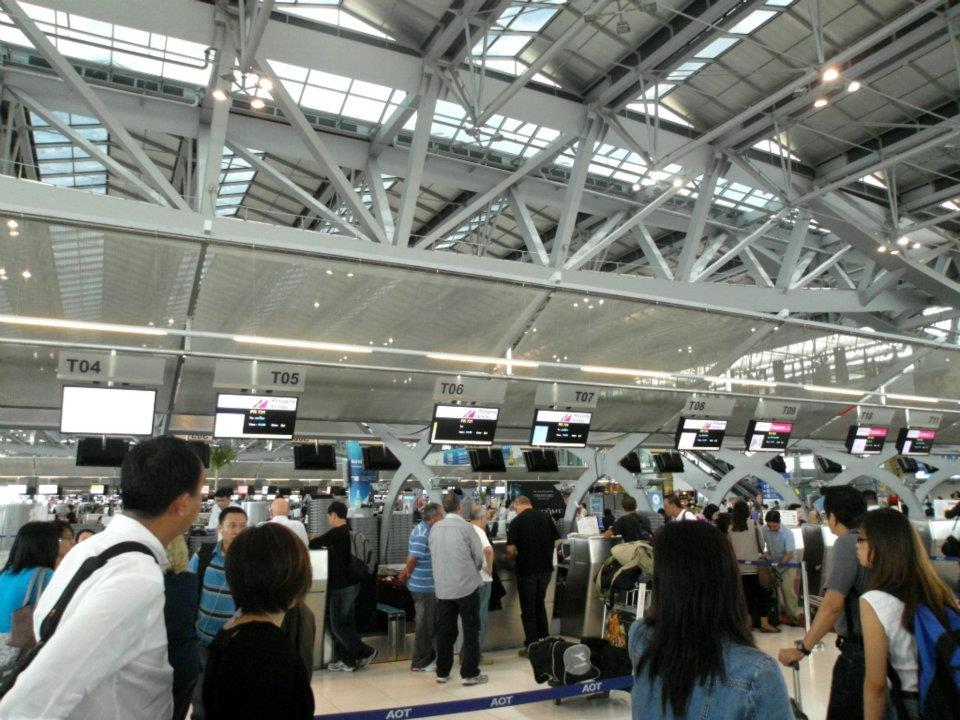
Check-in counter area at departure level.
Its main terminal is one long building with satellite buildings for gates shaped like a huge letter H.  The left area is mostly occupied by Thai Airways International (Suvarnabhumi’s home-based airline) while the middle and right H-arm of the terminal is dominated by foreign airlines.  The airport is complete with main amenities of international airports like day rooms, shower rooms, transit facility, lounges, transportation facility to downtown and numerous duty-free shops.

Arrival
Arrival is a just a breeze and quick but maybe because our plane parked at the gate that is directly linked to the main terminal building. It is because the terminal has a letter H style satellite. What if the plane parked on the edge of the H satellite? It would be a nightmare walk to the Arrival Immigration and Baggage Carousel Claim since both are located in the main terminal. Yes, there’s a lot of walkalator to aid but it still a long walk to the main terminal. I’m not sure but I hope they have an in-terminal shuttle service because the arrival pathway from far located gates is not friendly for those traveling elderly and family with infants and small kids.

Looking for transportation options are the arrival terminal is very tourist friendly. It’s easy to locate where to take a taxi, bus or train to the city. Plus loads of very helpful tourist pamphlets available that will help you on exploring Bangkok and Thailand for the first time!

Sawasdee ka...
Thai relics at the arrival concourse area.
Departure
If the arrival area has a very impressive architectural design, the departure area won’t be a disappointment in impressive structural design as well. The departure area has more natural lighting effect from the outside because of the ceiling design. And the ambiance here has more light and space but the “construction and industrial feel” is still there since it is the dominant concept design of the terminal. The huge glass panel designs we all a breeze of air inside the structure of the departure terminal. The main departure area of check-in counters is literally huge that’s why be careful to get lost inside while looking for your airline counters.

Orchid Garden at the departure area.
Departure area of Suvarnabhumi Airport.
Buddha Urn Reliquary at the center of departure area.
Overlooking at the planes in its huge glass panel design.
At the transit and duty-free area.
Butterfly orchids at the airport's departure area - they are attention drawing among passengers.
Though the terminal has this “construction” ambiance, it didn’t fail to put markings and relics of Thai culture to have the terminal a touch of Thailand, like having a Reliquary urn of Buddha ornamented with many Thai orchids and lined statues of Yakshas (demon guards in Thai) at the departure area of the airport. In the transit area and meeting points of the gate satellites, passengers will find numerous historical and cultural Thai relics that made the terminal define to be an “airport in Thailand.” Be ready for another dose of shopping as Suvarnabhumi Airport has so many duty-free shops to choose from that you’ll be literally tired if you explored them one by one!

I like the idea of how the gate area was put to concept at Suvarnabhumi Airport. Each gate per plane is separated solely from the waiting area of the other gates with full contained divider – making it easy for airline employees to locate missing passengers. And each gate has restrooms so no need for passengers to go up or go to other areas where there’s a restroom if he or she needs too. A huge Samsung flat screen TV in front of the gate waiting area is there to keep the passengers entertained while waiting for departure.

PR731 to Manila at Gate D3.
Airy and spacious Gate D3  while waiting for departure.
Conclusion
Suvarnabhumi Airport is one of the biggest airport I have been in my whole travel life, that’s why it makes me think that Suvarnabhumi Airport is also Thailand’s megastructure. Imagine, three buildings of SM Mall of Asia together just composed the main building of the airport. Satellite airside gates are not yet included. How big that is!?

Final Call already?!
I tried to stroll the whole airport just to savor how mega structure it is. I had a good sense of wonderment at first but it only gave me a tiring last hour stay in Bangkok’s main air gateway. It is really huge but the structural design of the whole was astonishing and amazing! For me plus points for the huge modern glass panel designs, they are always delight to my eyes. Minus points for me the steel, lifeless, construction/industrial feel design part of the airport because I feel nothing when I see them like lifeless and it seems to be an unfinished building.

Numerous airlines flies to Suvarnabhumi Airport. This is the main terminal building with gates.
Just one arm of the H-style satellite gates of Suvarbhumi Airport.
 The idea of a huge airport is nice to accommodate more flights and passengers but I’m not pro for huge airport that is so huge enough that it is not passenger friendly anymore. And Suvarnabhumi Airport hit some of those like getting into long walks both at the arrival and departure area especially in the arrival area going to the immigration counter and baggage claim carousel coming far edge gates of the terminal. This factor is not friendly for visitors who are elderly, senior citizens, and passengers traveling with infants and small kids.  There are walkalators but then again longs walks and pathways are still ahead. I’m not sure if there’s a shuttle service here.

Suvarnabhumi Airport is a hub airport in South East Asia region that’s why many airlines fly to this airport that some are not flying to Manila. It’s location in Bangkok is a nice option to get various connecting flights to other cities around the world especially bound to Europe. That makes the airport an ideal transit hub for passengers with connecting flights not just for tourists and visitors but also for seman crew and overseas workers.

Bangkok in the air!
Overall, Suvarbhumi Airport really gave me an impression of what and how a mega-structure airport is. Ideal as well, because it the complete amenities of an airport especially its function as a hub airport for transiting passengers going to other destinations. There maybe downside aspects to its huge structure but its design were really impressive – I’m amazed and stunned to it.   

----------------------------------------------------------------------
Suvarnabhumi Airport: Thailand's mega-structure is part of my Thailand's Amazing Smiles series where I share my wonderful trip to the land of amazing smiles last October 25-28, 2011. For a helpful trip to Bangkok visit Bangkok for Visitors website for more information. You might also like the other parts of the series:  

Tuesday, August 21, 2012

Airport Review: Davao International Airport

Davao International Airport (IATA: DVO), is the main airport serving Davao City and the busiest airport in the region of Mindanao. Formerly known as Francisco Bangoy International Airport, it is named after the patriarch of an influential family residing in the city who donated the land where the airport operates. The airport has a single 3,000-meter precision runway.

Welcome to Davao!!!
The current terminal replaces the previous airport terminal, which lie just across it, in handling both domestic and international flights operating to and from Davao. The P2.7 billion passenger terminal is a Malay architecture-inspired building which is four times larger than the old terminal. It is highly computerized, more secure and has more commercial spaces for concessionaires at approximately 9,000 sq. meter. It has four units of jet bridges for passengers. The terminal has 14 domestic and 14 international check-in counters that can handle a steady flow of passenger traffic. The Check-in counters are equipped with electronic weighing scales and conveyors and its baggage handling system is also computerized. It also has 2 arrival areas, for domestic and international with 2 baggage conveyors each. The Cargo Terminal Building covers almost 5,580 sq. meters and can handle up to 84,600 metric tons of cargo a year. The modernization and upgrading of the airport facilities aims to cement Davao as a hub for tourism and foreign investment in the region.

Welcome!!!
Initial construction began in 2000 while plans for construction were announced in 1992. After almost a decade, the new terminal was inaugurated on December 2, 2003. On November 12, 2007, Cebu Pacific announced this airport as its third hub.

The following airlines and their destinations currently serve Davao International Airport:
1.      Air Asia Philippines – Clark
2.      Airphil Express – Cagayan de Oro, Cebu, Clark, Iloilo, Manila, Zamboanga
3.   Cebu Pacifir Air – Butuan, Cebu, Cagayan de Oro, Dipolog, Iloilo, Kalibo, Manila, Puerto Princesa, Zamboanga
4.      Philippine Airlines – Manila
5.      Wings Air – Manado
6.      SEA (South East Asian) Air - Manila
7.      Silk Air – Singapore
8.      Zest Airways - Manila

(Information source: Wikipedia: Davao Airport)

I experienced being in Davao International Airport when I visited the city in Summer 2009.

Left outside facade of the airport.
Overview of the main terminal. Photo courtesy of Jetphotos.net
Building and Facilities
The terminal building is strikingly white-painted outside but what makes it more striking are the layered triangular shape Malay-inspired roof.  The pointed roof design also echoes Davao’s famed fruit king – Durian particularly its pointed thorn-like skin texture. The building’s predominantly white color with accents of gray and green creates an airy and spacious atmosphere. The choice of white as the predominant color also evokes a light feeling and mood along with the concept of maximizing the spaces of the building for handling larger capacity of passengers.  

The multi-floor terminal is designed to meet the international standards of an airport terminal. It serves both domestic and international flights and its capacity is designed to handle both type of flights. It has four jetways that has the capacity of handling a bigger plane like Boeing 747-400 of Philippine Airlines which is regularly deployed on the airport.  It can also handle mid-range and long-range aircraft types like Airbus 330-300 and Airbus 340-300 with its 3,000 meter runway. I think it can even handle a long-range Boeing 777-300ER aircraft.  

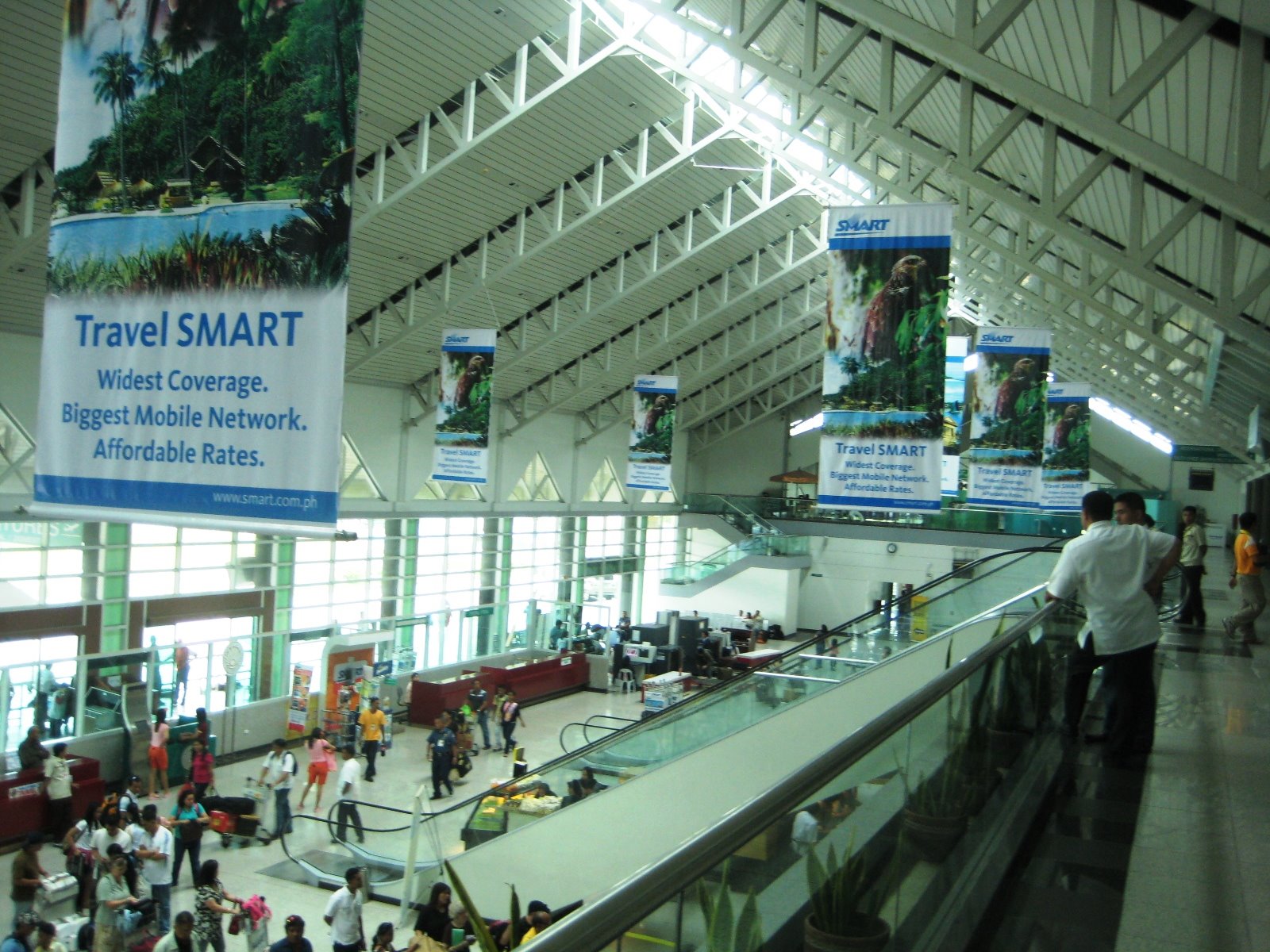
The Smart ad that designs the outside façade of the terminal facing the plane side added colors and Davao character to the dominantly white painted building of the terminal.

Mount Apo in the air!!!
Davao, here I come! On approach to the airport.
Arrival
My arrival to Davao was exciting and very much welcoming because in the air I was treated with a glimpse of Mount Apo! It’s the Philippines’ highest peak. I don’t know if it depends on aircraft approach but as our plane banks on an approach to Davao Airport, I saw a group of tall mountain peaks surrounded by clouds that one resembles the peak of Mount Apo. I knew that I saw the country’s tallest peak when I compare the pictures I took with the pictures of Mount Apo’s peak. I marvel in viewing Mount Apo in the air. It was a great welcome on my first time visit to Davao!

The arrival area is spacious with 4 baggage conveyors to ease claiming of check-in luggage. It has a friendly service desk for tourists who want to inquire about the tours around the city and getting transportation out of the airport. The outside façade has a line-up of numerous taxis available for transportation. But what I like about in Davao, is that these taxis are registered at the security desks before going out of the airport facilities for security reasons of the tourists and taxi scam fares. Most of the taxi drivers are naturally friendly and not forced. The Durian Monument designed by Kublai Milan, Davao’s famous artist found at the front facade was a great welcome for tourists and visitors who want to discover the city.

The striking Durian monument at the outside facade of the airport.
Departure
The glass doors and waiting area roofs are tinted in dark green color.  The Malay-inspired roof is also designed up to the roofs of waiting areas of the terminal building. These layers of pointed triangles also echoes the skin of Durian – Davao’s fame king fruit as I’ve observed before. The Malay-inspired roof is also reflected inside the terminal that looks like a big ceiling of a “Bahay Kubo” with modern and steel design. The ceiling has glass linings where natural sunlight can pass through and gives additional lighting inside the departure terminal. The glass designed walls were wide and tall to get more natural lighting get through inside the airport. I also noticed that the Malay-inspired pointed designs is also echoed in on top of these walls and resembles roofs of traditional Nipa hut house or “Bahay Kubo”.

Malay-inspired designed of Davao International Airport. Photo courtesy of Come Visit Davao.
View of the departure area from the terminal's second floor.
 International and domestic check-in counters are separated by a divider with an escalator that leads to the 2nd floor where the final checks, gates and lounges are located. The terminal is complete with immigration and final security checks for international flights. There are also souvenir shops, restaurants and cafes for passengers to enjoy while waiting for their flight. The 2nd second floor also has lounges for VIP passengers. One of the lounges is Mabuhay Lounge for Philippine Airlines’ business class and high miler passengers.

While the departure area has a grand designs of Malay inspirations, the gate area was ordinarily bland in design and majority where just painted in white and green carpeted. Wide glass walls facing the planeside give a view of airline operations and actions on-going in the airport. Davao International Airport has a terminal fee of 200PHP for domestic passengers.

Check-in counters at the departure area. Photo courtesy of Jetphotos.net
Gate holding area. Photo courtesy of Come Visit Davao.
Mabuhay Lounge of Philippines Airlines. Photo courtesy of Come Visit Davao.
Gate waiting area before passengers embark to the aircraft. Photo courtesy of Come Visit Davao.
My Conclusion
The location and space of the current terminal of Davao has a big potential for expansion in case it needs to expand for additional capacity, more flights and rising passenger flow. My impression when I first stepped inside the terminal was it looks like a mini version of NAIA Centennial Terminal 2. This is mainly because of its predominantly white color of the terminal inside and outside of the building including the glass inspired designs. But Davao International Airport still has a distinction because of its Malay and Durian-inspired designs.

The current space of the terminal is enough to serve the current capacity that the airport is handling currently. I just wish they redesign the gate holding areas for a more appealing architecture and did not resorted to a boring white atmosphere area. I think it would also be better if the cafes, shops and restaurants are near the gate holding area as most airport are designed that way. Unlike in Davao International Airport, they are located before entering the gate areas thus they are on a separate facility area of the terminal.

Samal Island and Davao in the air!
Since the terminal is an international airport, I hope the government and concerning agencies will promote the city to have more international flights. I feel that the international side of the terminal is underuse with only Silk Air and Wings Air serving the airport for international flights. Local airlines should be tapped for the potential of the airport to have international flights. Cebu Pacific’s move of making Davao as its third domestic hub was a great move.

Lastly, a departure flight from Davao, gives an air glimpse of beautiful Samal Island – one of the Davao’s tourism draws. The marvelous sights of this beach resort and adventure activity dotted island reminds me and all of us that Davao has a great role in shaping up Philippine tourism potentials.  
--------------------------------------------------------------
Airport Review is a section in Going Places where I gave a comprehensive review and insights to the airports that I have been in my travels. Review ranges from the airport's arrival and departure area, functionality, terminal structure, facility, airport location up to the unique amenities that the airport offers. These airport reviews will give travelers a first-hand experience of what it is to expect inside these airport terminals

Friday, April 27, 2012

Airport Review: Tagbilaran Airport

Tagbilaran Airport (IATA Code: TAG) is the airport gateway to Tagbilaran City and the province of Bohol  in Central Visayas. The airport is classified as a Principal Airport Class 1 by the CAAP, a body of the Department of Transportation and Communications responsible for implementing policies on civil aviation to assure safe, economic and efficient air travel, and the handling of operations on all airports except major international airports. The airport is currently served with daily Manila bound flights of Airphil Express, Cebu Pacific Air, Zest Air and Philippine Airlines and Cebu and Davao bound, Mid-Sea Express. It has one asphalt surface runway with a length of 5,837 feet and 1,779 meters. 

Tagbilaran Airport terminal building.
Our plane from Manila - PR175
I experience to be in the airport when I had my first visit to Tagbilaran, Bohol last Summer 2011 of March.

The Building and Facility
The airport building is two floor small building with no jetways for airplanes to docked with and transfer passengers from the the plane side to airport building side. The 1/4 of the ground floor is dedicated to a small arrival area while the bigger part of the ground floor is dedicated to the departure area. The second floor of the building occupies the management offices and airline ticket offices as well as the annex of departure waiting area for departing passengers before boarding.

The airport can only handle two airplanes on ground at the same time due to limited plane space in the airport. Meaning only two flights, two landings and two departures can only be accommodated on operational time of the airport. This measure of two planes at a time also regulates the flow and influx of passengers to the terminal building due to its limited space as well.

Welcome to the City of Friendship landmark just outside the airport.
Check-in counter of Philippine Airlines at departure area. Credits to Pinoy Photoblogger of flickr.com
Arrival
I notice that after deplaning from stairs, a lot of arriving passengers mostly Filipino tourist were starting to take on-ground pictures with the airplanes in the background. Picture taking takes time and on-ground security were instructing the passengers to do it quickly as most aircraft are turnaround flights and boarding is soon for departing passengers that might mix with the arriving passenger and can cause security breaches. I join the photoshoot as this is just an only chance experience to be near an airplane but made one quick shot only as security officers are gesturing the passengers to proceed immediately to the arrival hall.

The arrival area is small. I estimate that it only occupies 1/4 of the ground floor building with one baggage carousel for check-in baggage claim. It is an open area and non air-con facility. The area gets crowded when two arriving flights arrive at consecutive times.

It has one decent and clean restroom and has an easy exit out to the terminal. Upon exit to the terminal premises we were welcome by the city landmark's "The City of Friendship". This is in reference to Datu Sikatuna's Sanduguan or Blood Compact friendship agreement with the Spanish explorer Miguel Lopez de Legazpi during the Spanish rule times.

Check-in counters at departure area. Credits to Pinoy Photoblogger of flickr.com
Departure
Upon arrival at the terminal we were greeted again by the city landmark. Inside the departure area of the terminal is direct access to check-in counters. Though it is well ventilated, the terminal is hot in afternoon atmosphere with non air-conditioned facility and though it occupies most of the ground space of the terminal it still small for a public air terminal with quite number of flights to serve. The airport has a terminal fee for departing passengers of around 30-35 pesos each.

In the gate area, there is so much crowd waiting for the flight. It was 2 pm and our flight back is around 4:30 pm. Along with our flight is Zest Air and Cebu Pacific Air flight too where there are  passengers are also waiting for their departure. The gate area is overcrowded because of this situation and though it has a second floor for waiting passengers, it is still crowded. Even the stairs going up to the second floor is occupied on the sides by the waiting passengers. Me and my travel companions ended up standing while waiting for our flight. 

The ground floor also has the restroom and small kiosk shops for souvenir items. This time the area is air-conditioned equipped.    

Tagbilaran City's welcome landmark.
Second floor of gate area with waiting passengers.
After sometime when Cebu Pacific already start boarding, some of the space and seats in the gate were freed. But it was still crowded with two flights waiting for departure. Luckily we found seats to wait and relax before our departure at the second floor area of the gates.

The second floor of the gate area is fully occupied with seats for departing passengers. What I like in the floor are wide windows to view the incoming and outgoing aircraft movement in Tagbilaran Airport. The place is perfect for planespotting! Planespotting is one of my favorite hobbies so I shoot the best plane shots I can get from the windows as some fellow passengers are doing it as well.

Waiting to go home...
Flight PR 178 to Manila - the last flight of the day in Tagbilaran Airport.
We boarded on-time. As we board and handed our boarding passes to airport ground personnel, we were also serenaded by a band of native and local songs. I think that was a great way to end up my trip in Bohol. And a great way of Boholanos to say "thank you" or "daghang salamat" for visiting their little paradise.

We were again expose to a close encounter with an airplane because of stair boarding. After 10 minutes, the aircraft taxis the ramp, made a turn at the runway and flew at 4:45 pm. It was a smooth flight out of Tagbilaran City. 

Bohol in the air!
My Conclusion
While the terminal of Tagbilaran is enough for the passenger traffic, demand for air travel in Bohol especially with foreign and local visitors demands for terminal expansion. The terminal is small to accommodate the increasing flow of passengers incoming and outgoing to Bohol province. Most of the facilities from arrival to departure to aircraft space is not enough to accommodate the increasing number of passengers everyday. Four airlines with daily and multiple flights crowds the terminal and demands for its expansion for more space.

I think space is also the reason why only two aircraft movements are allowed in Tagbilaran Airport. Aside from limited terminal space, only two aircrafts can accommodate at the terminal's aircraft park. Space is limited to accommodate additional flight at the same time. That's why they limit aircraft landings and departures at the airport.

The gate area is the most crowded part of the airport. It needs expansion for more space since a lot of tourists are visiting Bohol every year. Its kinda shame to let passengers stand or sit in the stairs waiting for their flight because of limited seats in the terminal. There is no need for a Internet wi-fi facility or grand architectural terminal structure. Enough space and seats for passengers is good already for the airport.

Given the priority and funds for expansion by the airport authorities and government bodies, I think improvement is not far thing to happen with Tagbilaran Airport. Also given situations are the increasing demand of visitors to Bohol and its fame as a prime tourist destination in the country that calls for expansion and improvement. But unfortunately as I saw, it is quite difficult and complicated to expand more spaces to the terminal and facility of the airport as it is located in a residential area that limits it for space expansion. But with right planning or relocation like other major provincial airports, who knows? There also news of constructing an airport in Panglao Island to support its growing tourism industry but as of now, no official update and budget is on-going. But until then, Tagbilaran Airport must be prioritize first for improvement and expansion since it is the main gateway of the Bohol province and serves its capital city. 

--------------------------------------------------------------
Airport Review is the newest section in Going Places where I gave a comprehensive review and insights to the airports that I have been in my travels. Review ranges from the airport's arrival and departure area, functionality, terminal structure, facility, airport location up to the unique amenities that the airport offers. These airport reviews will give travelers a first-hand experience of what it is to expect inside these airport terminals.

Related Posts Plugin for WordPress, Blogger...